
Overview of Genetic Conditions: Causes, Types, and Testing
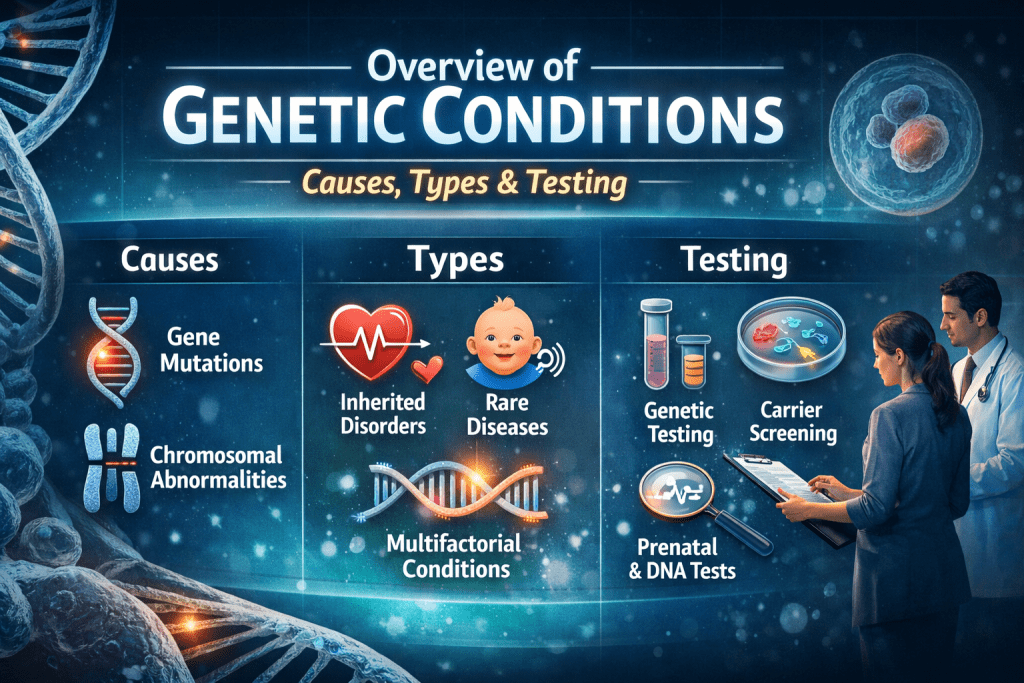
Genetic conditions are health disorders caused by changes in a person’s DNA, and they can affect almost any system in the body. An Overview of genetic conditions helps explain why some diseases run in families, why others appear unexpectedly, and how modern testing can identify risks earlier than ever. These conditions range from mild traits to serious lifelong illnesses, and their causes are not always inherited. Understanding the basics is important for making informed medical decisions, especially for family planning, early diagnosis, and targeted treatment.
What Genetic Conditions Are and Why They Matter
Genetic conditions are disorders linked to variations, errors, or disruptions in genetic material. DNA carries instructions for how the body grows, functions, and repairs itself, and even small changes can affect health. Some genetic conditions show symptoms at birth, while others appear later in childhood or adulthood.
Many people assume genetic conditions always come from parents, but this is not always true. Some occur due to new mutations that happen during early development. Others are influenced by a mix of genetic risk and environmental triggers.
A clear Overview of genetic conditions also helps reduce confusion between “genetic” and “hereditary.” A condition can be genetic without being inherited, and it can also be inherited without showing symptoms in every generation.
Causes of Genetic Conditions: Mutations, Inheritance, and Environment
The most direct cause of genetic conditions is a mutation, meaning a change in the DNA sequence. Mutations can affect a single gene, multiple genes, or entire chromosomes. The impact depends on what the altered gene normally does and how essential it is for normal function.
Genetic conditions can be inherited through several patterns. In autosomal dominant inheritance, one altered copy of a gene from either parent can cause disease. In autosomal recessive inheritance, a person usually needs two altered copies, one from each parent, to develop symptoms.
Some conditions follow X-linked inheritance, where the altered gene is on the X chromosome. These often affect males more severely because males have only one X chromosome. Females may be carriers or may show milder symptoms depending on the gene and how it is expressed.
Not all genetic risk is purely inherited. Many common diseases involve multifactorial inheritance, meaning genes and environment interact. For example, someone may have genetic risk for heart disease, but lifestyle factors such as diet, smoking, and exercise strongly influence whether the condition develops.
Major Types of Genetic Conditions
Genetic conditions can be grouped into several major categories. Each category is based on the kind of genetic change involved and how it affects the body. A strong Overview of genetic conditions should cover all of these clearly.
Single-Gene (Monogenic) Disorders
Single-gene disorders occur when a mutation affects one gene. These conditions often have predictable inheritance patterns. Examples include cystic fibrosis, sickle cell disease, and Huntington’s disease.
Because the cause is more specific, monogenic disorders are often easier to test for with high accuracy. However, severity can still vary widely between individuals. Some people may have mild symptoms while others experience serious complications.
Single-gene disorders are especially important in family history analysis. If close relatives have a known mutation, testing can clarify whether other family members are affected or are carriers.
Chromosomal Disorders
Chromosomal disorders happen when there are changes in the number or structure of chromosomes. Humans typically have 46 chromosomes, and having extra or missing genetic material can disrupt development. A well-known example is Down syndrome (trisomy 21).
Other chromosomal disorders include Turner syndrome and Klinefelter syndrome, which involve differences in sex chromosomes. Structural changes, such as deletions or translocations, can also cause disease. These changes may be inherited or may occur spontaneously.
Chromosomal disorders often cause developmental delays, physical differences, or fertility issues. Many are identified during pregnancy or early childhood, but some mild forms are not diagnosed until later.
Multifactorial and Complex Genetic Conditions
Multifactorial conditions result from the combined influence of multiple genes and environmental factors. These include many of the most common diseases worldwide, such as type 2 diabetes, hypertension, and coronary artery disease.
Unlike monogenic disorders, complex conditions do not follow simple inheritance patterns. A person may inherit risk variants from both parents, but the condition may never develop without environmental triggers. This is why family history increases risk but does not guarantee disease.
Complex genetics is also a major area of modern research. Many studies focus on identifying patterns of risk genes to predict disease earlier and personalize prevention strategies.
Mitochondrial Genetic Disorders
Mitochondrial disorders involve mutations in mitochondrial DNA or in nuclear genes that affect mitochondrial function. Mitochondria are responsible for producing energy, so these disorders often affect high-energy organs like the brain, muscles, and heart.
A key detail is that mitochondrial DNA is typically inherited from the mother. This creates a unique inheritance pattern that differs from standard Mendelian genetics. Symptoms can vary greatly even within the same family.
These disorders are often difficult to diagnose because symptoms overlap with many other diseases. Specialized testing and clinical evaluation are usually required.
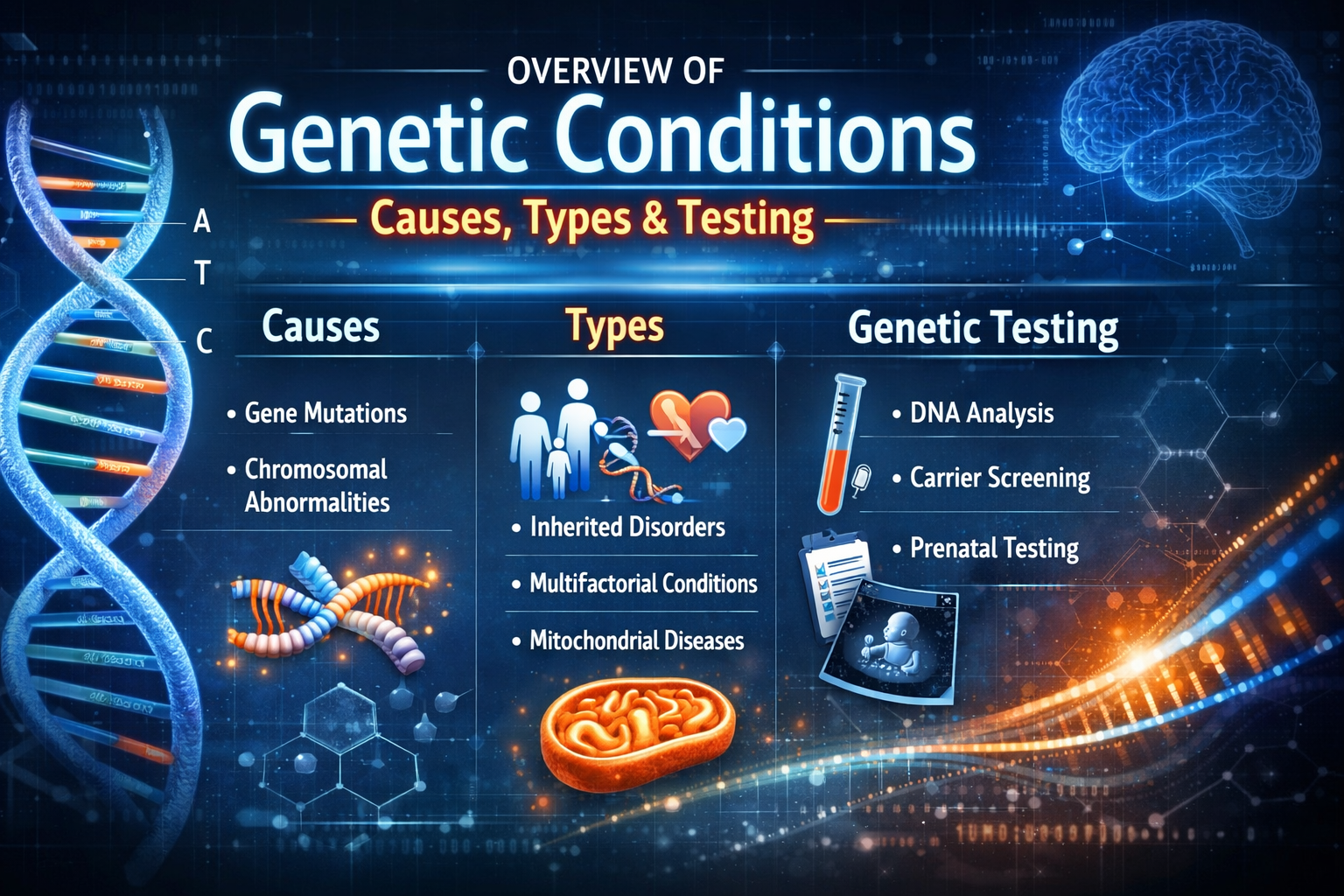
Signs, Symptoms, and When Genetic Conditions Are Suspected
Symptoms of genetic conditions depend on which genes are affected and how strongly they influence body function. Some conditions cause obvious physical traits, while others affect metabolism, brain function, or immunity. Many genetic disorders involve multiple systems, creating complex symptom patterns.
Genetic conditions may be suspected when symptoms appear early in life, when a disease is unusually severe, or when it does not respond to standard treatments. Another major clue is a strong family history of the same disorder. Repeated miscarriages, infertility, or children with unexplained developmental delay can also suggest a genetic cause.
Doctors may also suspect a genetic condition if multiple relatives have related problems, such as early cancers or heart disease. Certain patterns, like cancer occurring at young ages across generations, can indicate inherited mutations. In these cases, genetic testing can guide both diagnosis and prevention.
Genetic Testing: Methods, Accuracy, and What Results Mean
Genetic testing is the process of analyzing DNA, chromosomes, or proteins to identify genetic changes. Testing can confirm a diagnosis, predict future risk, or determine carrier status. It is a core part of any modern Overview of genetic conditions, because testing is now widely used in both clinical and preventive care.
Common Types of Genetic Tests
Carrier screening checks whether a person carries a mutation that could be passed to children. This is often done before pregnancy or early in pregnancy. It is especially relevant for autosomal recessive disorders. Diagnostic testing is used when symptoms already exist. For example, a child with developmental delay may receive chromosomal microarray testing or sequencing to find the cause. Diagnostic testing can shorten the “diagnostic odyssey,” where patients spend years without clear answers. Predictive or presymptomatic testing is used when a person has a family history of a known condition. For example, testing for a Huntington’s mutation can identify risk before symptoms begin. This type of testing has serious emotional and life-planning implications. Pharmacogenetic testing looks at genetic variants that affect how the body processes medications. It can help reduce side effects and improve treatment success. This is increasingly used in psychiatry, oncology, and pain management.
Major Testing Technologies
Karyotyping is a classic method that examines chromosomes under a microscope. It can detect large changes such as extra chromosomes or major rearrangements. It is useful for conditions like trisomies and certain infertility issues. Chromosomal microarray (CMA) detects smaller deletions or duplications that karyotyping may miss. It is commonly used for developmental delay, autism spectrum disorders, and congenital anomalies. CMA has become a first-line test in many pediatric evaluations. Single-gene testing targets one specific gene, usually when a doctor strongly suspects a particular condition. This approach is highly focused but may miss other possible causes. It is often used when the clinical picture is very clear. Gene panels test a group of genes associated with a specific disease category. For example, hereditary cancer panels examine genes linked to breast, ovarian, and colon cancer risk. Panels balance efficiency with accuracy by narrowing the search to relevant genes. Whole exome sequencing (WES) analyzes all protein-coding regions of the genome. Because many known disease-causing mutations occur in coding regions, WES is powerful for diagnosing rare disorders. However, it may miss changes in non-coding regions and certain structural variants. Whole genome sequencing (WGS) examines nearly the entire genome, including coding and non-coding regions. WGS can detect a wider range of variants, but it is more expensive and produces more complex data. Interpretation is still a major challenge.
Understanding Genetic Test Results
Genetic test results are not always a simple “yes” or “no.” A result may identify a pathogenic variant, meaning it is known to cause disease. It may also identify a likely pathogenic variant, meaning evidence strongly suggests it is harmful.
A common and confusing outcome is a variant of uncertain significance (VUS). This means a genetic change was found, but current science cannot confirm whether it causes disease. Over time, VUS results may be reclassified as more research becomes available.
A negative test does not always mean there is no genetic risk. It may mean the test did not cover the relevant gene, or the mutation is not yet known to science. This is especially important in complex conditions where many genes contribute small effects.
Benefits, Limitations, and Ethical Considerations
Genetic testing has major benefits for diagnosis and prevention. It can provide clarity after years of uncertainty, guide treatment choices, and help families understand recurrence risk. In some cases, testing enables early screening that prevents severe outcomes.
However, testing also has limitations. Not all genetic variants are interpretable, and results may be uncertain. Some tests miss certain mutation types, such as deep intronic variants or mosaic changes, depending on the method used.
Ethical concerns are also central. Genetic information can affect family members, not just the individual tested. A positive result may reveal unexpected family relationships or raise difficult questions about whether relatives should be informed.
Privacy and discrimination concerns also matter. While many countries have legal protections, people still worry about how genetic data could be used by insurers or employers. Because of this, genetic counseling is often recommended to help patients understand both medical and personal implications.
Conclusion
An Overview of genetic conditions shows that these disorders arise from mutations, inheritance patterns, chromosomal changes, and gene-environment interactions. Genetic conditions range from rare single-gene diseases to complex disorders influenced by lifestyle and multiple genes. Modern genetic testing can clarify diagnosis, identify risk, and support prevention, but results must be interpreted carefully due to uncertainty and ethical considerations.
FAQ
Q: What is the difference between a genetic condition and a hereditary condition? A: A genetic condition is caused by DNA changes, while a hereditary condition is specifically inherited from parents. Some genetic conditions are new mutations and are not inherited.
Q: Can genetic conditions appear even if no one in the family has them? A: Yes. Some occur due to new mutations or chromosomal changes that happen spontaneously during early development.
Q: What does a “variant of uncertain significance” mean in genetic testing? A: It means a DNA change was found, but current research cannot confirm whether it causes disease. It may be reclassified later as science improves.
Q: Is genetic testing always accurate? A: Testing is highly accurate for detecting many variants, but accuracy depends on the method and what types of mutations it can detect. Interpretation can still be uncertain.
Q: When is genetic testing most commonly recommended? A: It is commonly recommended when there is a strong family history, unexplained symptoms, developmental delays, recurrent pregnancy loss, or suspected inherited cancer risk.
