Trump Officials Removed Over 50 Park Exhibits for Disparaging Americans
Trump officials removed more than 50 park – Following a federal court ruling, the Department of Justice (DOJ) described the effort to restore removed national park installations as “herculean and unmanageable.” The changes, initiated under the Trump administration, involved the removal of historical displays that highlighted slavery, civil rights movements, and climate change impacts across at least 37 sites. These alterations were part of a broader campaign to reshape narratives in public spaces, as outlined in court documents.
The Scope of the Changes
According to court filings, the National Park Service (NPS) eliminated more than 50 exhibits, some of which were entirely discarded. The administration’s directive focused on eliminating content that “inappropriately disparage Americans past or living,” with an emphasis on removing references to slavery, civil rights struggles, and climate change. Additionally, signage that officials deemed “unrelated to the beauty, abundance and grandeur of the natural landscape” was also taken down, signaling a shift in priorities from historical and scientific narratives to a more sanitized version of American history.
The removals came after a federal judge issued a preliminary injunction, halting further modifications to national parks and requiring weekly progress reports from the administration. U.S. District Judge Angel Kelley in Massachusetts criticized the efforts, stating that the Trump administration was attempting to “rewrite the Nation’s history with a white-out pen.” Her ruling highlighted the importance of including diverse perspectives in historical accounts, particularly those of marginalized communities whose contributions and challenges are integral to the nation’s story.
“History cannot be faithfully told while excluding the experiences of communities whose contributions, struggles, and achievements form an important part of our Nation’s story,” Kelley wrote in her order.
The judge further noted that the administration’s actions were not merely about promoting American dignity, but about “sharing a limited history” by erasing exhibits that did not align with their preferred narrative. This selective approach, she argued, led to “half-truths” that ignored the complexities of the country’s past. The decision has sparked debates about the role of public institutions in preserving historical accuracy.
A Federal Lawsuit Challenges the Narrative
A separate federal lawsuit accuses the NPS of “mounting a sustained campaign to erase history and undermine science” after President Donald Trump issued an executive order titled “Restoring Truth and Sanity to American History.” The order aimed to counter what the administration called a “revisionist movement” that depicted the United States as “inherently racist, sexist, oppressive, or otherwise irredeemably flawed.”
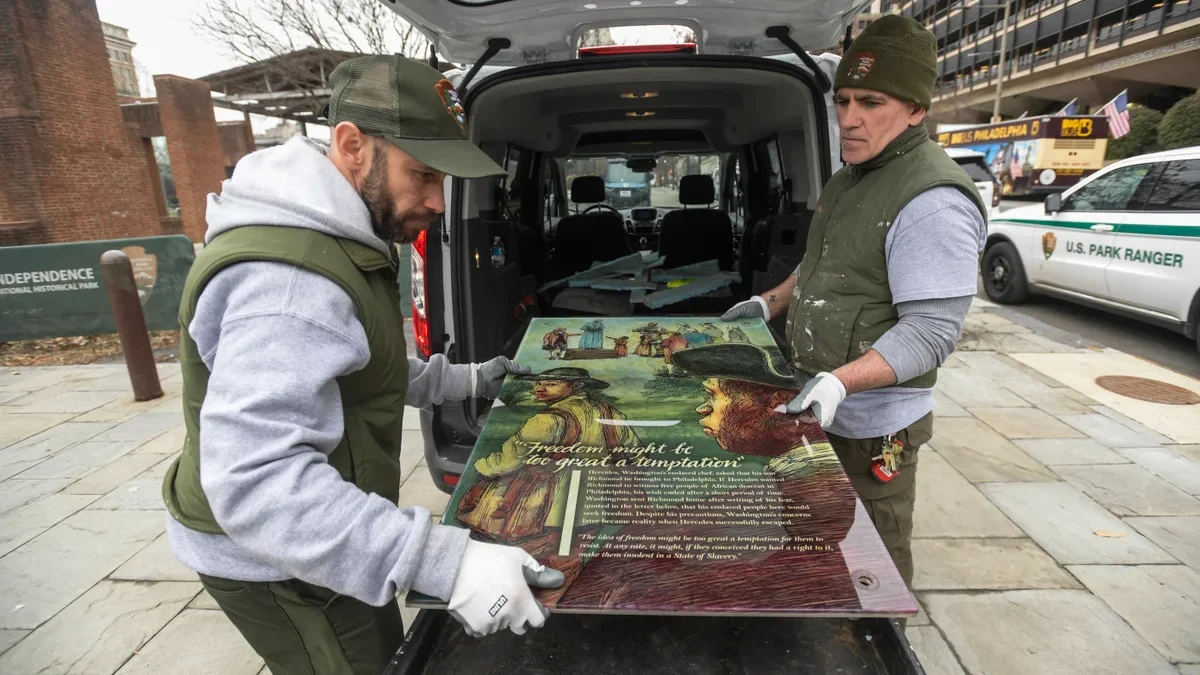
The directive required park officials to review and revise exhibits that depicted “founding principles and historical milestones in a negative light.” As a result, several displays focusing on the brutality of slavery, the civil rights movement, and environmental issues were either removed or altered. This included an exhibit at Philadelphia’s Independence National Historical Park that described enslaved people owned by George Washington, which was taken down under the order.
The administration’s efforts to reshape history have drawn comparisons to George Orwell’s dystopian novel, 1984. In February, a judge in a separate case likened the removal of exhibits to the Ministry of Truth’s role in controlling historical records. However, an appeals court recently overturned an order mandating the restoration of all slavery-related content at the Philadelphia site, complicating the nationwide effort to reverse these changes.
Expanding the Impact on Public Narratives
The revised exhibits have also affected the representation of Native American history, the military service of Black Americans during the Civil War, and labor history in the U.S. Visitors reported that information about these topics was either deleted or minimized, reflecting a broader effort to downplay systemic issues. The administration further criticized the Smithsonian Institution for emphasizing the “how bad slavery was” perspective, instead advocating for a focus on the “brightness” and “future” of America.
President Trump also threatened to withdraw federal funding from museums that portrayed American and Western values as “inherently harmful and oppressive.” This approach has led to the removal of materials that discuss climate change, as they were seen as detracting from the “beauty, abundance and grandeur of the natural landscape.”
In response to the changes, the administration invited park visitors to report any exhibits they believed depicted “negative” aspects of the United States. The feedback lines were flooded with criticism from the public, who argued that the removals represented a deliberate attempt to rewrite history for political purposes.
Challenges in Restoration
Lawyers for the Trump administration have defended the changes, stating that restoring the removed installations would require a “herculean and unmanageable task.” The process, they claim, could take “weeks or months,” with the Department of Justice anticipating completion only after July 4. This timeline suggests that the revised narratives may remain in place for an extended period, despite ongoing legal challenges.
The removals have raised concerns about the balance between preserving historical accuracy and promoting a more positive national identity. Critics argue that by erasing references to slavery, civil rights, and climate change, the administration is sidelining key aspects of American history that reflect both its triumphs and its struggles. The case underscores the tension between historical interpretation and political influence in public spaces.