
Record haul of rare Yuan Dynasty blue-and-white porcelain discovered at shipwreck off Singapore
Record haul of rare Yuan Dynasty blue-and-white porcelain discovered at shipwreck off Singapore
A significant find of blue-and-white porcelain has emerged from a shipwreck near Singapore, offering new insights into the Chinese craftsmanship of the Yuan era. The vessel, estimated to be about 650 years old, was likely en route from China to Temasek, a historical hub that now occupies modern Singapore. This discovery, detailed in a recent study, includes a remarkable quantity of Yuan Dynasty ceramics, setting a new record for such finds.
Michael Flecker, a marine archaeologist with Heritage SG, described the effort required to uncover the ship’s cargo. His team spent four years excavating the 14th-century wreck, which was located in shallow waters but presented formidable challenges. Strong currents and poor visibility limited diving to once every four weeks, according to Flecker. “We were sometimes thrown around on the seabed or had to navigate back to the line in darkness,” he noted, highlighting the difficulty of the task.
Unique Designs and Historical Clues
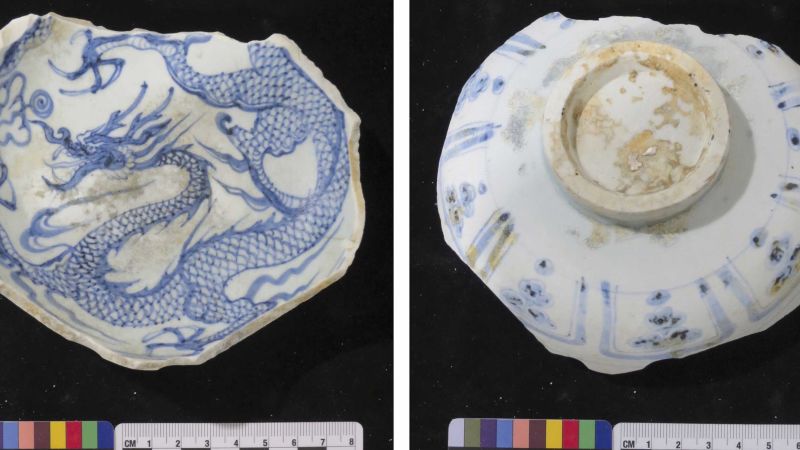
Among the 3.5 metric tons of ceramic fragments recovered, approximately 136 kilograms were identified as Yuan porcelain. Despite the ship’s disintegration, enough intact pieces remained to reveal distinctive motifs. One design features a four-clawed dragon, while another shows a phoenix framed by chrysanthemums. The most common pattern, mandarin ducks in a lotus pond, helped Flecker pinpoint the ship’s time period. This design was exclusive to Emperor Wenzong during his reign from 1328 to 1332. After his overthrow, the motif became widely available through commercial kilns, which produced much of the porcelain for export.
“This is crockery, it’s not prized in the same way as gold, painting, calligraphy or the greatest architecture,” said Shane McCausland, a professor of art history at SOAS University of London. “Yet, it’s something to do with the translucency, the incredible hardness of it, it’s a kind of material that is a bit miraculous.”
McCausland added, “There’s even a belief that it has magical properties—if you put poison on it, it would crack. That partly explains why paranoid rulers would like to have a bit of blue-and-white.”
Trade Networks and Cultural Impact
The porcelain also sheds light on the trade routes of the time. Made by Chinese artisans, the ceramics incorporated cobalt from Persia, now Iran, before being distributed via the silk roads under Mongol rule. Flecker noted that the ship’s origin is likely Quanzhou, a key port on China’s eastern coast known for its maritime activity. “As soon as the Mongols retreated from China in 1368, the knowledge that this blue-and-white was a breakthrough of the Yuan period got lost,” McCausland explained. “Scholars in the 1930s would misidentify it as coming from other dynasties, questioning the Mongols’ role in its creation.”
Further analysis suggests the ship could have sunk between the late 1320s and 1371, after the fall of the Yuan Dynasty and before the Ming era. This timeframe aligns with the period when the Mongols controlled key trade routes, enabling the spread of this unique ceramic style across Eurasia. The find underscores the cultural and technological legacy of Yuan porcelain, even as its production declined following the dynasty’s collapse.
