
Poland’s PM Tusk defies president’s veto over €43.7 billion EU defence loan
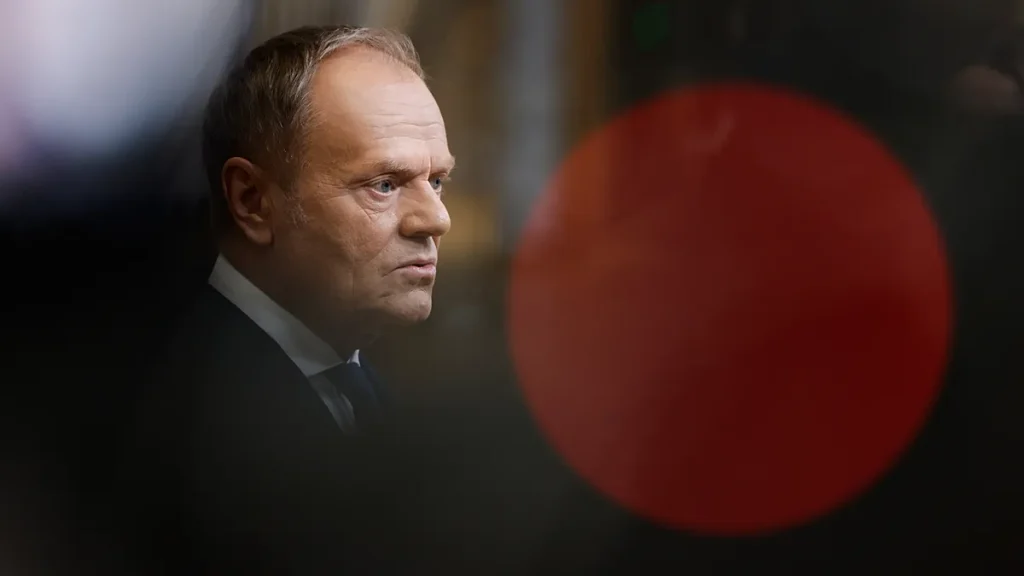
Poland’s PM Tusk Defies President’s Veto on €43.7 Billion EU Defence Loan
Prime Minister Donald Tusk of Poland has refused to back down after President Karol Nawrocki vetoed a bill authorizing €43.7 billion in EU defence loans. Tusk emphasized Friday that the government will pursue the funds regardless, despite the presidential objection. “Poland is in shock,” he remarked. “People are questioning whether this is treason, the influence of lobbyists, or a failure of shared judgment.”
President’s Concerns Over Sovereignty and Debt
President Nawrocki, who cast his veto on Thursday, criticized the legislation for undermining Poland’s autonomy. “I would never endorse a law that threatens our sovereignty, independence, and security,” he stated. “Any effort to raise foreign debt through improper channels will eventually face consequences, both politically and legally.”
“Politicians pushing for this loan must understand — it will saddle our future generations with a massive financial burden,” Nawrocki added. “Poles will repay as much as the loan’s value, while Western banks profit from this arrangement.”
Poland was poised to become the largest recipient of the EU’s €150 billion initiative aimed at strengthening European defence capabilities. The US has been reducing its involvement in continental security, creating a gap that the EU seeks to fill. Nawrocki warned that the loan would burden the nation for decades, with interest costs potentially reaching 180 billion złoty (€42.1 billion).
Government’s Resolve and Alternative Plans
Tusk maintained that the veto would not halt access to the defence funds, though it would complicate the process. “It will be slower and require more effort to secure agreement,” he said. “But military modernization will continue. We will not let this chance slip away.”
“The president’s veto will not stop us. We will build full sovereignty through the Polska Zbrojna programme,” Tusk declared. “This initiative is a priority for Poland’s security.”
The European Commission reiterated its commitment to advancing the plan without delay. A preliminary payment might be released as early as April, according to a spokesperson. Meanwhile, the dispute escalated to the Sejm, where heated exchanges occurred during parliamentary debates.
Political Divide and Strategic Shifts
Nawrocki, a vocal critic of the EU’s role in Poland’s security, argued that the SAFE initiative would deepen reliance on Germany. He proposed an alternative draft law, suggesting national resources instead of European loans for military upgrades. Tusk dismissed the idea as impractical, while the government called the proposal lacking in thorough analysis.
Defence Minister Władysław Kosiniak-Kamysz defended the SAFE agreement, asserting it was crafted in Warsaw, not Brussels. “The European Commission adopted this proposal at Poland’s request, not the other way around,” he stated. “The plans for military modernization remain unchanged, as the Polish army staff drafted them.”
“Withdraw from this, and history will remember your hesitation,” Kosiniak-Kamysz said. “By 2030, the Polish army will be the strongest in Europe.”
Przemysław Czarnek, a PiS candidate for prime minister in the upcoming November 2027 election, criticized the loan as “illegal” during a Sejm session. He insisted that a formal international agreement, approved by both legislative chambers, is necessary before borrowing such a significant amount.
Since Russia’s invasion of Ukraine in early 2022, successive Polish governments have increased defence spending. However, Tusk’s liberal administration prioritizes EU collaboration, contrasting with Nawrocki’s more skeptical stance toward the bloc. The president has also expressed support for Washington’s critiques of SAFE.
