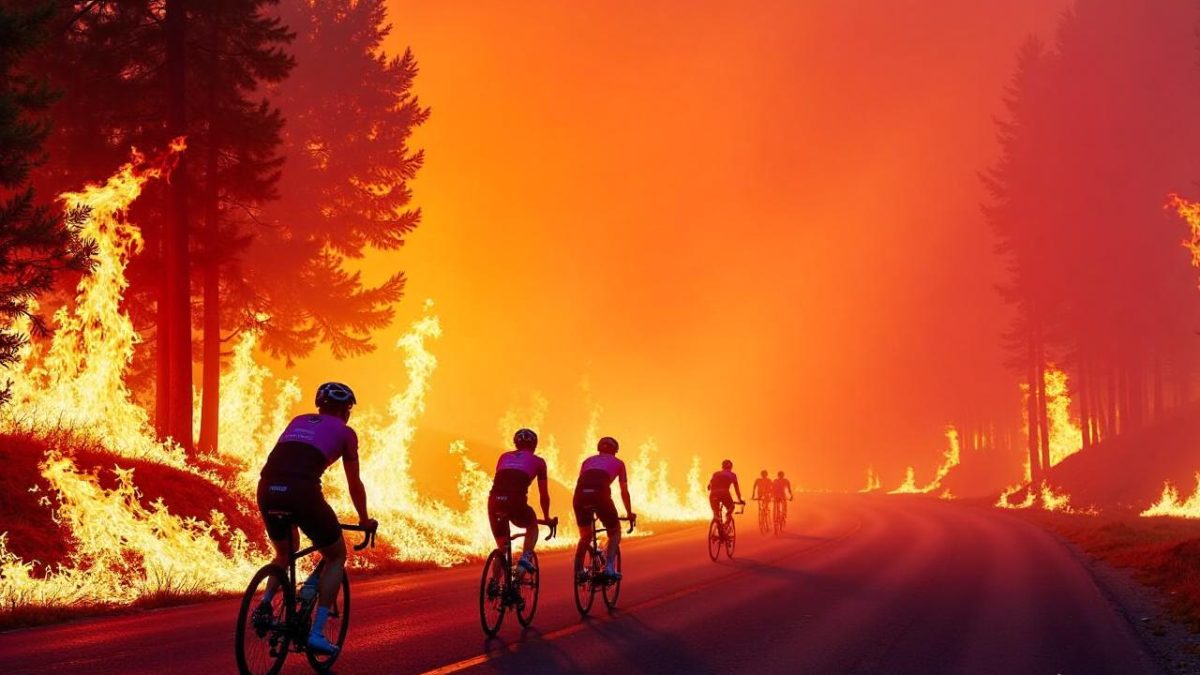
French Wildfires Disrupt Tour de France Stage 3 Amid Safety Concerns
French wildfires force Tour de France – The Tour de France’s third stage faced an unexpected closure to the public on Sunday due to a rapidly spreading forest fire in southwestern France. Officials confirmed the decision, citing the imminent threat posed by the blaze, which is located approximately 60 kilometers from the stage’s finish line in Les Angles. The race, which kicked off in Barcelona on Saturday, has now been forced to adapt its logistics to ensure the safety of participants and spectators.
Fire Threatens Race Route and Surrounding Areas
The wildfire has scorched over 1,600 hectares of land, creating hazardous conditions for cyclists and spectators alike. Visible from the race route, the flames are producing thick black smoke that has blanketed the region. Eyewitness accounts describe scorching winds, intensely hot ground, and difficulty breathing near the affected zone, with visibility limited to less than two meters. These conditions have raised concerns about the safety of the event’s proceedings.
Race director Christian Prudhomme emphasized that the Tour’s organizers are prepared to adjust the route if necessary. “An exceptional fire calls for exceptional measures for the Tour,” he stated, highlighting the proactive stance taken by the event’s leadership. While the race route itself remains unchanged, the Tour’s publicity caravan has been instructed to bypass the final 40 kilometers of the French border from Spain, where it commenced on Saturday. This adjustment aims to reduce congestion and free up security personnel to focus on firefighting efforts.
“An exceptional fire calls for exceptional measures for the Tour,” said race director Christian Prudhomme, underscoring the need for flexibility in the face of unforeseen challenges.
Cyclists will continue their journey without the usual support staff, relying on a minimal team to maintain operations. This shift has been approved by the prefecture of the Pyrenees-Orientales department, which oversees the region. The decision reflects the urgency of the situation, as the fire continues to expand despite containment efforts.
Wildfires Across Europe Complicate Race Dynamics
The incident in France is part of a larger trend of extreme heat and wildfires sweeping across Europe. Blazes in both France and Spain have intensified safety concerns for this year’s Tour de France, which began its route in Barcelona. In Catalonia, where the first two stages took place, a separate wildfire in the Les Gavarres area has been stabilized, though high temperatures and smoke continue to challenge extinguishing efforts.
The Catalan fire, which erupted on Friday near the Costa Brava, is believed to have been caused by a worker using a circular saw on a road. Sparks from the tool are thought to have ignited the vegetation, leading to the rapid spread of flames. Local authorities have arrested the suspect, who was identified as the individual responsible for the incident.
While the French fire remains active, officials have deployed significant resources to control its spread. Over 750 firefighters, 200 vehicles, and nine helicopters are currently on the scene, working to establish a 18-kilometer front line. The goal is to prevent the fire from advancing further toward the Tet River and the arid Aspres region, which is particularly vulnerable due to its geography.
No fatalities have been reported so far, though two individuals—one firefighter and a resident—are in critical condition. The prefecture of the Pyrenees-Orientales department has urged the public to avoid the race route and finish line, enabling security teams to allocate their focus entirely to combating the blaze. This precautionary measure also helps minimize risks to spectators and nearby communities.
Regional Fire Risk Assessments and Broader Implications
Meteo France has classified seven southern departments as facing a “very high fire risk” on Sunday, underscoring the severity of the situation. The Pyrenees-Orientales department, where the main fire is concentrated, is under constant monitoring to assess the potential for further expansion. Meanwhile, the impact of the wildfires on the Tour de France highlights the challenges of hosting such a high-profile event in the midst of environmental crises.
The closure of stage 3 has prompted discussions about the resilience of the race’s infrastructure. While the route remains intact, the reduction in public access has created logistical hurdles for the organizers. The race’s ability to maintain its schedule despite these disruptions is a testament to its preparedness, though the event’s trajectory may still be affected by the evolving fire conditions.
In addition to the French fire, the situation in Spain has also raised concerns. The Catalan blaze, though contained, has left lingering smoke and heat that could influence the race’s upcoming stages. Cyclists are expected to navigate these conditions with caution, as the combination of high temperatures and poor air quality may impact performance and health.
The decision to close the third stage reflects a balance between safety and the continuation of the event. Race organizers are prioritizing the well-being of athletes and staff while striving to keep the Tour on track. As the fires continue to burn, the focus remains on minimizing their impact on the race and protecting the surrounding environment.
The wildfires serve as a stark reminder of the unpredictable nature of extreme weather events. With climate change exacerbating such conditions, the Tour de France’s management is adapting to ensure the safety of all involved. This stage’s closure is a necessary step in mitigating risks, but it also highlights the broader challenges posed by the growing frequency of such disasters in Europe.
As the race progresses, the interplay between human activity and natural disasters becomes increasingly evident. The fires in France and Spain not only threaten the Tour’s logistics but also underscore the need for sustainable practices in the region. The resilience of the event, however, remains a key focus, with officials working tirelessly to address the immediate concerns while planning for future stages.
The Tour de France’s response to the wildfires has been swift and strategic. By adjusting the publicity caravan and allowing cyclists to proceed with limited support, the race demonstrates its ability to adapt to unforeseen circumstances. The upcoming stages will likely face similar challenges, but the event’s organizers are confident in their capacity to manage the situation effectively.