
Should you worry about the Ebola outbreak? Here’s what the numbers tell us
Should You Worry About the Ebola Outbreak? Here’s What the Numbers Tell Us
Should you worry about the Ebola – As of late May, a significant Ebola outbreak has emerged in the Democratic Republic of Congo (DRC) and Uganda, raising concerns about its potential impact. The World Health Organization (WHO) has classified the situation as a “public health emergency of international concern,” though it emphasizes that global risks remain relatively low. This outbreak is attributed to the Bundibugyo strain, which lacks a specific treatment or vaccine, according to recent tests. The strain has already claimed at least 148 lives, with health officials reporting 51 confirmed cases and 575 suspected infections in the DRC alone.
A Critical Timeline of the Outbreak
The WHO identified the outbreak in early May, following an alert about an unknown illness with a high mortality rate in the DRC’s Ituri province. Four health workers died within four days of each other in the town of Mongbwalu, prompting the organization to declare the emergency. However, the detection process was delayed, with the first known patient falling ill in April but the disease only being recognized in May. This “critical four-week detection gap” allowed the virus to spread unchecked in the region before intervention efforts began.
Rapid Spread and Regional Concerns
Experts warn that the outbreak’s rapid progression poses a substantial threat at the national and regional levels. The Bundibugyo strain, which is less commonly seen than others, has proven challenging to control. Health officials in the DRC are actively monitoring over 800 contacts, but the exact extent of the virus’s spread remains unclear. “We have significant uncertainty about the number of infections and how far the virus has spread,” said Dr. Anne Ancia, WHO’s representative in the DRC, highlighting the ongoing challenges in tracking the outbreak’s full scale.
The American Patient and Global Response
One American healthcare worker, who was treating patients in Bunia, DRC, has tested positive for the virus. The individual arrived in Berlin on Wednesday and is receiving care at Charité University Hospital, as confirmed by German authorities. The patient, Dr. Peter Stafford, a general surgeon specializing in burn care, is currently stable. In response, the U.S. Centers for Disease Control and Prevention (CDC) has arranged for six of his close contacts to be transported to Europe for observation. Five will be placed in Germany, while one will be cared for in the Czech Republic, as per CDC statements.
Healthcare Workers as Key Vulnerable Groups
Dr. Tedros Adhanom Ghebreyesus, WHO’s director-general, underscored the danger faced by healthcare workers during the outbreak. He noted that the virus’s spread has been exacerbated by significant population movement within the affected areas and the lack of a specific vaccine or treatment for the Bundibugyo strain. “The outbreak was slow to be identified,” Tedros explained, adding that this delay contributed to its escalation. “Potential spread of Ebola warrants serious concern,” he stated, emphasizing the need for swift action.
Imported Cases in Uganda
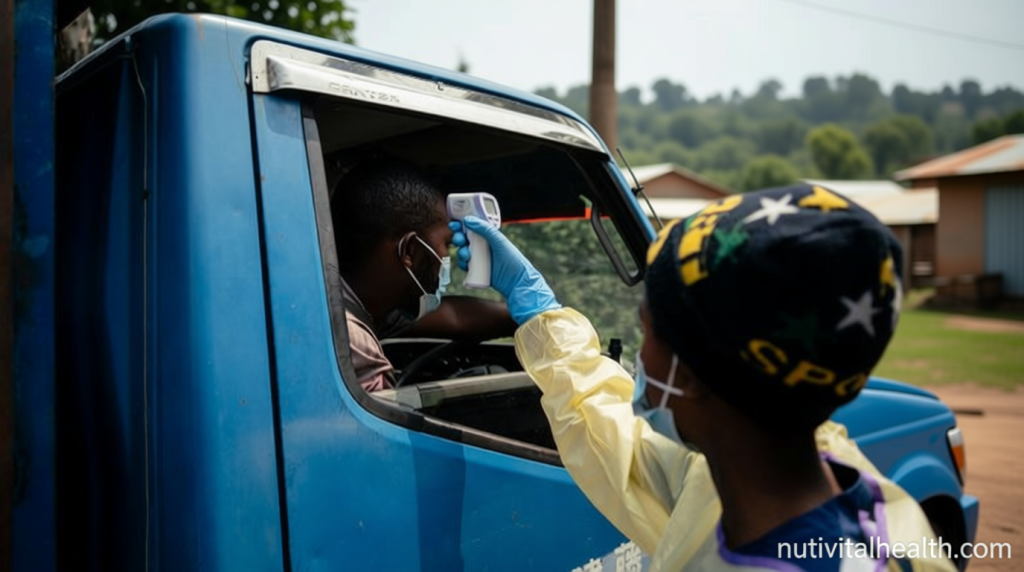
Uganda has reported two confirmed cases of Ebola as of Tuesday. The first was a patient from the DRC who received treatment at a Ugandan health facility but later succumbed to the disease. The second case is also considered imported, linking the outbreak to the DRC. Ugandan authorities have activated outbreak control measures, including enhanced disease surveillance, travel screenings, and readiness for emergency response. These steps aim to prevent further cross-border transmission.
How Ebola Spreads and Its Symptoms
Understanding the transmission dynamics of Ebola is crucial for containment. The virus spreads through direct contact with bodily fluids such as blood, saliva, sweat, or vomit from an infected person. It can also be transmitted via contaminated objects or surfaces, as well as through fecal matter. The incubation period, the time between exposure and symptom onset, ranges from two to 21 days. However, individuals are not contagious until they begin displaying symptoms, which typically include fever, fatigue, and vomiting, though they can progress to severe hemorrhagic fever.
The Role of Quarantine and Monitoring
Quarantine and monitoring protocols are central to managing the outbreak. Dr. Rebekah Stafford, Dr. Peter Stafford’s wife, and Dr. Patrick LaRochelle, another physician, may have been exposed to the virus but remain asymptomatic, according to Serge. These individuals are continuing to follow established protocols, which include regular health checks and isolation if symptoms develop. The movement of high-risk contacts to Europe underscores the global vigilance required to prevent local outbreaks, even in countries with robust healthcare systems.
Global Measures to Halt Spread
In response to the outbreak, several countries have implemented measures to limit the virus’s spread. Travel restrictions from the DRC have been enforced, and screening processes at airports and border crossings have been intensified. Additionally, resources have been dispatched to the region to support containment efforts. Despite these actions, the WHO maintains that the global risk remains low, as the outbreak is still localized. However, the potential for international spread cannot be ignored, especially given the movement of infected individuals across borders.
Challenges in Case Tracking
Accurately tracking the number of Ebola cases presents a major challenge. While 51 cases have been officially confirmed in the DRC, 575 are suspected, indicating a possible underreporting of infections. This discrepancy is due to the difficulty in diagnosing the disease early and the logistical hurdles in reaching remote areas. Dr. Anne Ancia noted that without clear data, predicting the outbreak’s trajectory is complex. “The detection gap has created uncertainty about the virus’s reach and the number of affected individuals,” she explained, calling for improved surveillance and reporting mechanisms.
Looking Ahead: Preparedness and Prevention
As the WHO continues its investigation into the outbreak’s origin and spread, the focus remains on preventing further escalation. Dr. Tedros highlighted the importance of addressing the detection gap and ensuring healthcare workers have adequate protective measures. The situation also serves as a reminder of the virus’s capacity to cross borders, even with stringent protocols. While the global risk is low, the regional impact is high, and the absence of a specific treatment for the Bundibugyo strain adds to the urgency of containment efforts. The ongoing monitoring of contacts and the swift response from international partners underscore the global commitment to mitigating the outbreak’s consequences.
