The World Cup is Here: A Guide to English Football Culture for US Fans
A Nation’s Unfulfilled Dream
The World Cup is here – For the last eight years, England’s national football team has teetered on the brink of glory, often leaving fans in a state of near-exaltation and quiet frustration. The men’s squad, in particular, has displayed flashes of brilliance that feel just short of transformative, while the women’s team has consistently performed with a composure that borders on effortless. This pattern has shaped the national psyche, where anticipation for the 2026 World Cup is both a familiar refrain and a fresh opportunity. As the tournament expands to North America, England’s football culture remains a curious blend of expectation and improvisation.
When the World Cup arrives in the United States and Canada, one of the most striking contrasts will be the differing rhythms of fandom. While English fans are steeped in a tradition of communal celebration and ritual, the American audience is still finding its footing in the art of collective chanting. Recent data from Google Trends reveals that the most common queries about football chants in the US revolve around the basics: “How do fans know what to sing?” and “How do chants begin?” These searches suggest a cultural divide, where the UK’s chants are often spontaneous, evolving from grassroots enthusiasm, whereas US fans may rely more on structured guides or pre-planned sequences.
Yet, this summer’s World Cup promises to be a learning curve for both sides. English fans will likely observe how the American crowds adapt to the game’s flow, while US spectators may marvel at the depth of England’s vocal traditions. The idea that a nation’s football culture can be distilled into a few key habits is both reductive and revealing—particularly when considering the UK’s approach to matchday rituals.
The Pub as a Sacred Space
At the heart of English football culture lies a symbiotic relationship between the pub and the pitch. Before stadiums became sprawling, multi-tiered arenas, matches were often played in open fields or small local grounds, and the pub served as the unofficial arena. Fans would gather in these establishments, raise a few pints, and then march to the stadium in a procession of camaraderie and anticipation. This ritual, which English football enthusiasts refer to as “Saturday,” is not just a tradition—it’s a social contract.
Watching football in England is as much about the journey as it is about the game. The act of meeting at the pub, sharing stories, and building a shared sense of purpose becomes part of the experience. Even after the match ends, the tradition continues: fans return to the pub to debrief, analyze, and debate the performance, regardless of the result. This relentless cycle of drinking, watching, and discussing has created a culture where the stadium is the extension of the pub, and the pub is the prelude to the stadium.
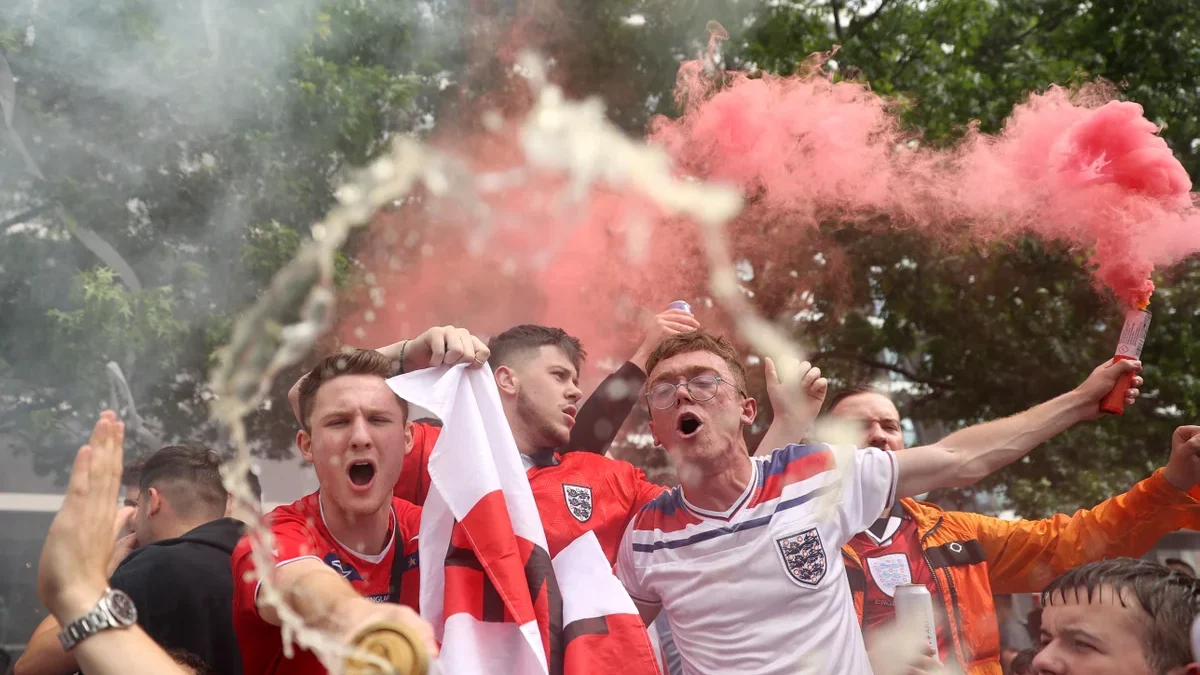
Of course, this isn’t without its quirks. When the team scores, the air fills with a chorus of pints being launched into the sky—a tradition that dates back decades. These moments of exuberance are not merely celebrations but acts of collective catharsis, where the physicality of the ritual mirrors the intensity of the game. The UK’s football chants, while often rooted in decades-old history, also have a modern, evolving edge, shaped by the likes of viral moments and social media trends.
Chants: A Cultural Symphony
Football chants in England are more than just noise—they are a form of cultural expression, a shared language that transcends the language barrier. While the US may still be experimenting with its own traditions, English fans have long embraced the power of vocal unity. One of the most iconic songs, “Southgate You’re the One, You Still Turn Me On—Football’s Coming Home Again!” is a prime example. This anthem, built on the 2000 pop hit “Whole Again” by Atomic Kitten, reflects both the national mood and the creative energy that fuels England’s chants.
The origins of such songs are often serendipitous, born from a single fan’s idea or a spontaneous group of supporters. As one report from The Independent noted during the 2018 World Cup in Russia, the phenomenon of Croydon’s fans—dubbed the “spirit of the tournament”—was a testament to this organic process. “It had taken several thousand plastic pints of beer and, as one bewildered news report put it, ‘clouds of fermented mist’ but Croydon was now the benchmark for something. Just two minutes from East Croydon station…” This image captures the essence of how chants become part of a national identity, evolving through repetition and shared experience.
What sets English football culture apart is its ability to blend nostalgia with innovation. While the old songs like “You’ll Never Walk Alone” remain staples, newer anthems often emerge from the chaos of the moment. The team’s performance, the referee’s decisions, or a viral moment on social media can all spark a chant that quickly spreads through the crowd. This adaptability ensures that the culture remains alive, even as the game itself changes.
Hydration Breaks: A New Rhythm
As the World Cup moves to the US, FIFA has introduced a new element to the game: hydration breaks. These three-minute pauses, inserted 22 minutes into each half, aim to address the UK’s long-standing criticism about the lack of rhythm in American football matches. For English fans, this development may feel like an intrusion on the natural flow of the game, which is often played without the interruptions of commercial breaks.
“For every game, no matter where the games are played, no matter if there’s a roof, [or] temperature-wise, there will be a three-minute hydration break,” stated Manolo Zubiria, chief tournament officer. This statement highlights a shift in the tournament’s structure, one that reflects the priorities of the host nations. While the break is ostensibly for player hydration, its timing and purpose suggest it may also serve as a commercial opportunity, a tactic that aligns with American sports broadcasting habits.
Interestingly, Spanish-language broadcaster Telemundo has taken a different approach, choosing not to air commercials during these breaks. This decision underscores a desire to preserve the unbroken flow of the game, a nod to the traditional English model. For fans accustomed to the uninterrupted rhythm of a match, these breaks may feel like an interruption—yet they also offer a chance for the crowd to engage in a new kind of collective expression, one that is both planned and participatory.
In the end, the World Cup is not just a test of skill but a showcase of culture. For US fans, navigating England’s football traditions will require both patience and curiosity. From the communal pub culture to the spontaneous chants, every aspect of the game is a testament to the nation’s deep, if sometimes unpredictable, passion. As the 2026 tournament unfolds, it will be fascinating to see how these traditions evolve, and how the shared experience of football can bridge the gap between two very different worlds of fandom.