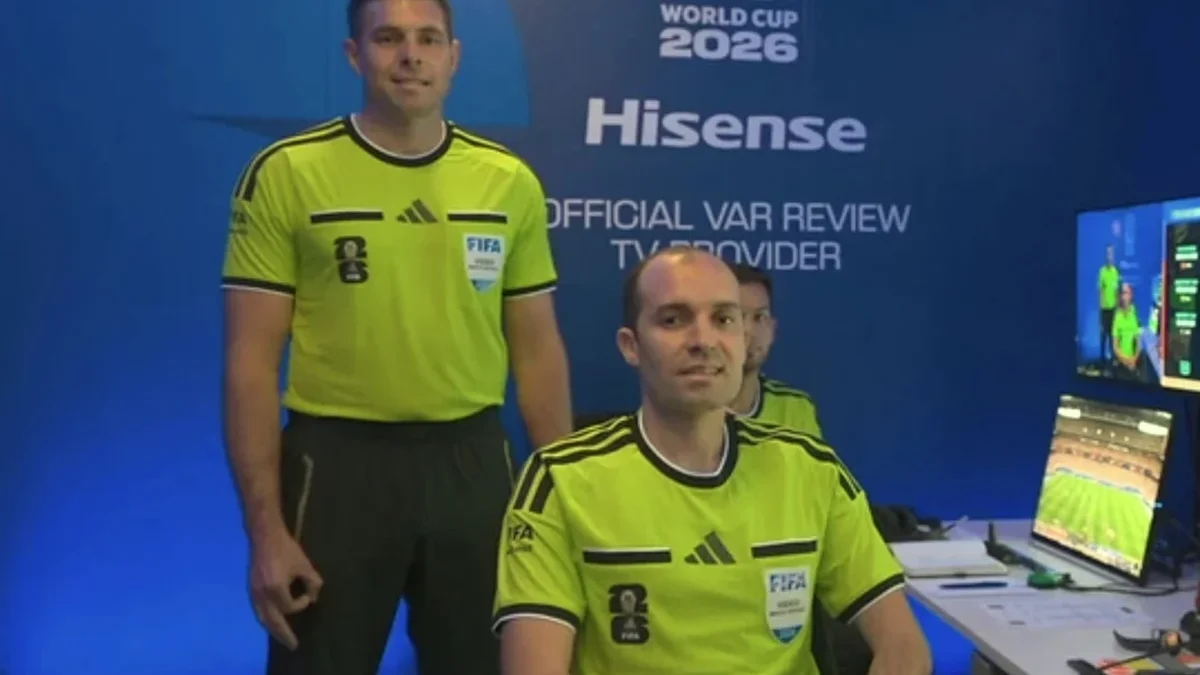
World Cup VAR Official Releases Statement After Alleged White Supremacist Hand Gesture
World Cup VAR official releases statement – Shaun Evans, an Australian referee serving as a Video Assistant Referee (VAR) official at the World Cup, has issued a statement clarifying a controversial hand gesture he made during Germany’s opening match against Curaçao on Sunday. The incident, captured during the broadcast, sparked immediate debate and accusations of white supremacist symbolism, prompting a swift response from Evans to defend his actions.
Denial of Intentional Symbolism
FIFA, the governing body of international football, confirmed that Evans was part of the VAR team based in Dallas, Texas, during the event’s broadcast operations. The moment in question occurred when the live coverage cut away from pre-game footage to display the team of video analysts. Evans was seen making an “OK” symbol with his right hand, positioned in front of his right leg. The gesture, which involves forming a circle with the thumb and forefinger while extending the other fingers, has been interpreted in various ways depending on context and intent.
Evans emphasized that the motion was not deliberate, stating it was an “involuntary, subconscious twitch.” He claimed to have been “unaware” of the gesture at the time, highlighting that it was a spontaneous action rather than a calculated symbol. “The coverage following this incident simply does not reflect who I am,” he said in his statement, which was released after FIFA concluded an investigation into the matter.
Historical Context of the Gesture
The hand sign in question has a complex history, with its meanings evolving over time. Originally, the “gotcha” or “circle game” is a playful children’s prank where participants show an upside-down “OK” symbol below their waist, and anyone who notices it is greeted with a shoulder punch. This lighthearted tradition has, however, been co-opted by far-right groups online, notably through a hoax that circulated on the 4chan message board a decade ago. The gesture was then associated with white supremacy, as some users adopted it as a coded signal.
Evans’ actions during the broadcast reignited this debate, with critics suggesting the gesture could have been a subtle nod to the symbol’s broader implications. The Anti-Defamation League, based in New York, had previously highlighted the gesture’s use as a hate symbol in 2019, linking it to far-right ideologies. Despite this, Evans maintained that his movement was entirely unintentional and not connected to any political or racial messaging.
FIFA’s Response and the Investigation
FIFA released a statement confirming there was “no evidence of breaches of the Fifa Disciplinary Code” in relation to Evans’ gesture. The organization’s investigation found no wrongdoing, though it acknowledged the public’s concern over the symbolism. “We have reviewed the footage and determined that the hand gesture does not constitute a violation of our standards,” the statement read.
Evans, who is in his first World Cup assignment, faced scrutiny for the incident, with some suggesting it was a playful or mischievous act. The gesture, while simple in form, carries weight in certain cultural and political contexts. Evans’ explanation of its spontaneity sought to downplay the controversy, but the moment remains a point of discussion within the football community.
Cultural Appropriation and Interpretation
The “OK” symbol, commonly used to signify approval, has been both a source of joy and a target of criticism. Its dual meaning has led to confusion, with the same hand movement being interpreted as either a harmless gesture or a deliberate political statement. The Anti-Defamation League’s 2019 analysis of the symbol’s usage in far-right circles has further amplified its symbolic significance, particularly in moments where it appears in public spaces.
Evans’ case underscores the importance of context in understanding gestures. While the symbol may have been used by white supremacists online, the referee’s action was described as a fleeting, unconscious movement. “I understand how the gesture has been interpreted and I regret this,” he added in his statement, though he stressed that it was not done knowingly or deliberately.
The incident also raised questions about the role of VAR officials in representing the values of FIFA. As part of the team responsible for reviewing matches, Evans’ gesture was seen as a potential reflection of the organization’s cultural identity. However, his statement aimed to reassure fans that his actions were not aligned with any discriminatory ideology.
Evans’ explanation of the gesture as a subconscious twitch aligns with similar incidents in sports history, where athletes have been accused of symbolic gestures only to later clarify their intent. This case, however, has taken on a unique significance due to the global audience of the World Cup and the widespread awareness of the symbol’s historical use.
As the tournament progresses, the incident serves as a reminder of how quickly gestures can be interpreted in different ways, especially in a multicultural environment like the World Cup. While Evans has defended his actions, the controversy highlights the broader conversation around symbolism in sports and the potential for even small actions to carry significant meaning.
Conclusion and Public Reaction
Evans’ statement has been met with mixed responses. Some have praised his transparency, while others continue to question the timing and nature of the gesture. The VAR official’s account of the incident, combined with FIFA’s clearance, offers a balanced perspective on the event. However, the debate is likely to persist, especially as the World Cup continues to bring diverse groups together under one global stage.
For now, Evans remains focused on his role as a referee, emphasizing that his gesture was a minor lapse rather than a statement. “I want to be very clear and categorically say that I did not knowingly or deliberately make the hand symbol suggested,” he reiterated. As the tournament moves forward, the incident will serve as a case study in the intersection of culture, politics, and sports, illustrating how even the smallest actions can spark large-scale discussions.