Medical Students in Haiti March to Demand Reopening of Major Public Hospital Amid Police Fire
Protesters Call for Government Action to Restore Access to Critical Healthcare Services
Medical students in Haiti march to demand – On Wednesday, a group of medical students in Haiti took to the streets to urge their government to relocate and reopen one of the country’s largest public hospitals. The demonstration, which focused on the University Hospital of Haiti—commonly referred to as the General Hospital—highlighted the students’ frustration over the facility’s prolonged closure. They emphasized that training at the hospital is essential for their development as doctors and for ensuring healthcare access for the broader population.
The students began their protest at the university’s main campus in downtown Port-au-Prince, donning white coats to symbolize their profession. Their march was initially peaceful, with participants moving in organized lines toward the outskirts of the prime minister’s office. Anti-riot police stationed along the route attempted to block their progress, creating tension as the students pressed forward. According to eyewitnesses, the police used tear gas to disperse the crowd, but the demonstrators remained resolute, continuing their procession despite the obstacles.
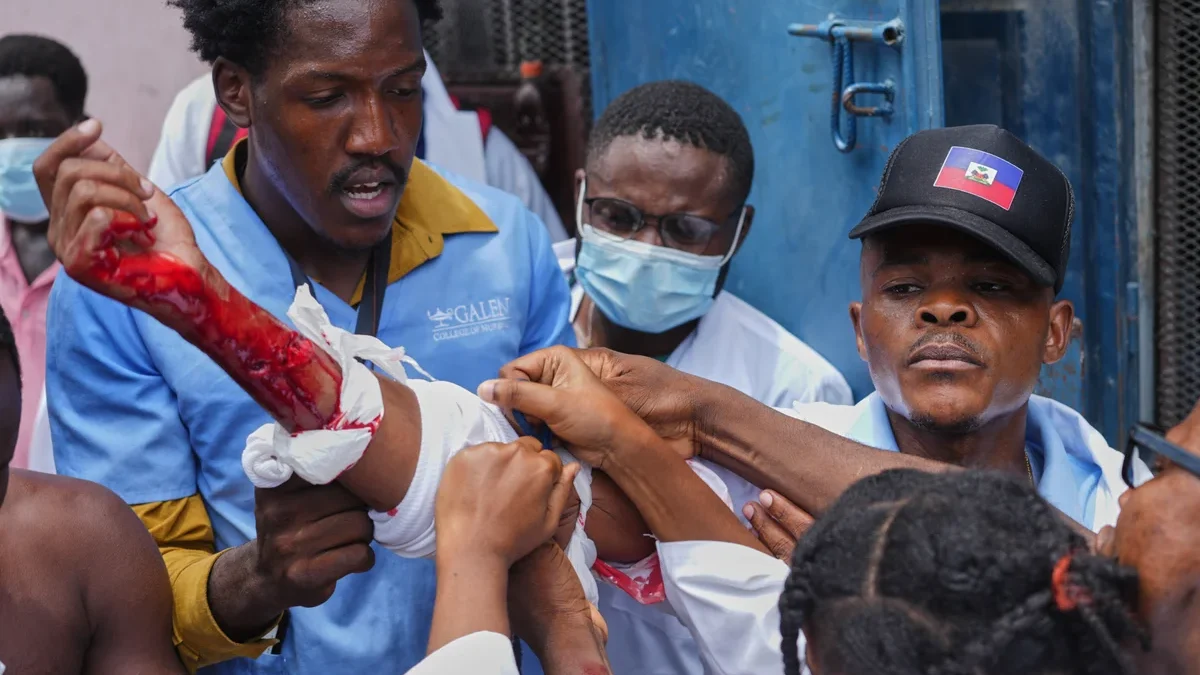
During the protest, an Associated Press journalist reported that a uniformed officer fired a shot into the air to break up the group. As the officer lowered his weapon, he fired a second time, striking a student in the arm. “We are not armed!” the students shouted, confronting the officer and hurling rocks at his vehicle. The attack caused multiple windows to shatter, escalating the situation as the police responded with force.
“Not only did the police use tear gas on us, the police fired live bullets at us,” said Esdras Paul, president of the faculty of medicine council. “We have students who are actual victims who are being cared for. We condemn this because we are holding peaceful demonstrations.”
The closure of the General Hospital was attributed to escalating gang violence in 2024. After months of instability, the government attempted to reopen the facility on Christmas Eve that year, aiming to restore essential healthcare services. However, the reopening was met with resistance as suspected gang members opened fire, killing two journalists and wounding seven others. A police officer was also fatally shot during the incident, underscoring the dangerous environment.
Johnson “Izo” André, a prominent figure in the Viv Ansanm gang coalition and widely regarded as Haiti’s most powerful gang leader, took responsibility for the attack. In a video posted on social media, he claimed that his group had not authorized the hospital’s reopening, suggesting that the violence was a deliberate act against the government’s efforts. This statement deepened the students’ anger, as they viewed the closure as a direct threat to their training and the people they were meant to serve.
Following the incident, the government swiftly removed the health minister from his position, signaling a shift in priorities. The General Hospital has remained closed since then, leaving thousands without access to critical medical care. Medical student Jean Pierre expressed the group’s demand during a recent protest, stating, “The prime minister needs to hear that the work we do is for the people in Haiti.”
In February 2025, the situation worsened when gangs set fire to the General Hospital, further damaging its infrastructure. This has placed an immense strain on the remaining open health institutions, which have been forced to absorb the hospital’s patient load. The closure of the hospital has contributed to a broader crisis, with approximately 70% of public health facilities shut down last year due to gang violence. This has deprived an estimated 4.4 million Haitians of essential healthcare services, compounding the challenges faced by the nation’s medical system.
The recent protest by medical students is part of a growing movement against the government’s inability to secure the hospital’s operation. Despite their peaceful nature, the students have faced harsh repression, including the use of live ammunition. This incident has reignited calls for accountability, with protesters arguing that the government’s failure to protect the hospital undermines its commitment to public welfare.
Haiti’s healthcare infrastructure, already fragile, has been further weakened by the prolonged closure of the General Hospital. The facility, once a cornerstone of medical education and care, now stands as a symbol of the challenges facing the country’s health sector. Students and medical professionals alike have expressed concerns about the long-term consequences of the hospital’s inaccessibility, warning that it will have lasting effects on the nation’s ability to respond to crises.
The protests have drawn attention to the systemic issues contributing to the hospital’s closure, including security concerns and political neglect. While the government has taken steps to address the situation, such as removing the health minister, the underlying problems persist. The students’ demands reflect a broader call for action to ensure that healthcare remains a priority in the face of ongoing gang activity.
As the protest continues, the students remain determined to advocate for their cause. Their efforts highlight the intersection of education, healthcare, and security in Haiti, where the struggle for stability directly impacts the ability to provide essential services. With the General Hospital still closed, the movement for its reopening grows stronger, driven by the belief that healthcare must be restored for the people of Haiti.