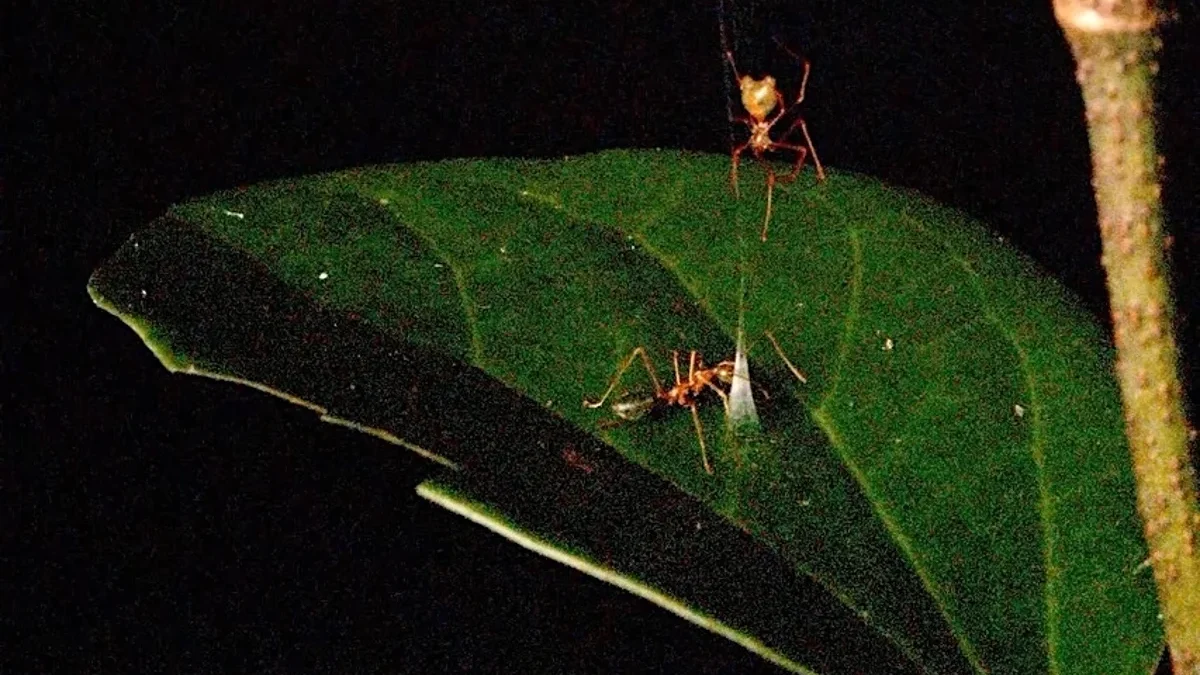
Australian Scientists Discover Spider with Spring-Loaded Ant Trap
New spider that hunts dangerous ants – Scientists in Australia have identified a novel spider species that hunts dangerous ants using an advanced spring-loaded mechanism, marking a significant breakthrough in arachnology. This remarkable discovery, made in the lush rainforests of northern Queensland, reveals an extraordinary predatory strategy that defies traditional expectations of how spiders interact with their environment. The newly named ballista spider employs a unique system of elastic silk threads to ensnare and launch its prey, showcasing an evolution of efficiency and precision in the insect world.
A Precision-Driven Hunting Technique
The ballista spider’s method of capturing prey is both innovative and finely tuned. By weaving a series of elastic silk threads, it creates a trap capable of propelling ants with force comparable to a mechanical catapult. This technique allows the spider to target the aggressive green tree ant *Oecophylla smaragdina*, a species known for its defensive swarms and stinging capabilities. Researchers describe this as a highly specialized adaptation, emphasizing the spider’s ability to manipulate ant behavior to its advantage.
Unlike conventional predators, the ballista spider doesn’t actively pursue its targets. Instead, it waits patiently in its web, relying on the ants’ predictable movements to trigger the trap’s release. The mechanism involves storing elastic energy in the web’s structure, which is then released in a rapid, calculated motion to immobilize the ant. This passive yet effective approach has intrigued experts, who note its resemblance to ancient Roman ballistae in both function and design.
Evolutionary Mastery in Web Design
The trap’s construction is a testament to evolutionary ingenuity. The ballista spider builds a web that appears as a simple tunnel but operates with complex mechanics. During the day, it hides beneath leaves, positioning itself near ant trails. As darkness falls, it begins its intricate web-building process, crafting a cone-shaped structure that later becomes a launching pad. This multi-step process can take up to four hours, demonstrating the spider’s strategic patience and technical skill.
What makes this web particularly effective is its dual purpose. It serves as both a snare and a projectile system, allowing the spider to capture and transport ants away from their colonies. Dr. Ajay Narendra, a researcher from Macquarie University, explains that “the web’s design ensures the ant is fully entangled before the elastic release, maximizing the chance of a successful hunt.” This precision has sparked discussions about the spider’s role in shaping its ecosystem through specialized predation.
Why Target Dangerous Ants?
Ants are typically resilient due to their collective defenses, including alarm signals and coordinated attacks. However, the ballista spider has adapted to overcome these challenges. Its focus on *Oecophylla smaragdina* suggests a deep ecological understanding, as the spider exploits the ant’s territorial aggression and predictable behavior patterns. By targeting a single species, the spider minimizes energy expenditure while maximizing capture efficiency, a strategy that has evolved over time.
This specialized approach also reduces the risk of confrontation with entire ant colonies. The spider’s ability to isolate individual prey without provoking a swarm response highlights its evolutionary advantage. The trap’s design not only immobilizes the ant but also ensures its swift capture, demonstrating a mastery of both engineering and ecology. Such behavior challenges previous assumptions about spider hunting techniques and underscores the diversity of survival strategies in nature.
Research and Technological Insights
The discovery was made by Greg Anderson, a biomedical scientist and arachnoid enthusiast, who observed the spider’s behavior during field studies. His findings led to a dedicated research project involving Macquarie University scientists, who spent 10 days in the rainforest near Cooktown to document the spider’s techniques. Using high-speed and infrared cameras, they captured the precise mechanics of the trap, revealing how the spider harnesses elastic energy to execute its hunting strategy.
Experts describe the ballista spider’s technique as a “miniature catapult disguised as a tunnel,” a metaphor that captures its deceptive simplicity and explosive effectiveness. The process involves a delicate balance of web construction and timing, with the spider waiting for the perfect moment to launch its prey. This innovation not only enhances the spider’s hunting success but also provides insights into the broader evolution of predator-prey dynamics in tropical ecosystems.