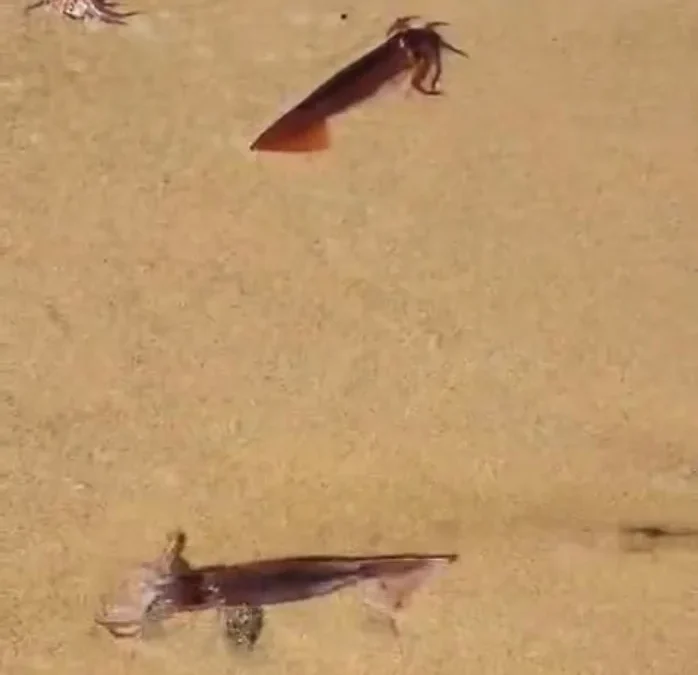
Cape Cod Experiences Unusual Squid Carcass Accumulation on Shore
Cape Cod sees thousands of squid – Recent days have brought an unexpected spectacle to Provincetown’s coastline on Cape Cod, Massachusetts, as thousands of squid carcasses have gathered along the shore. Local officials reported the phenomenon on Saturday, noting the unusual sight of wriggling, brown-tinged bodies lining the beach. While the scene might initially appear concerning, the Harbormaster’s Office has assured the public that the event is a natural occurrence tied to the squid’s life cycle.
The office shared a video showcasing the remains of the thin-bodied marine invertebrates scattered across the water’s edge. Though some of the creatures still exhibited faint movement as waves interacted with their forms, the overall scene was described as a mass spawning die-off. According to the Harbormaster’s Office, this is a common outcome for the Atlantic longfin inshore squid (Doryteuthis pealeii), which migrate toward coastal areas to reproduce.
“What you’re seeing is the Atlantic longfin inshore squid at the end of its life cycle,” the office explained. “These squid migrate inshore to spawn—and like many species, the adults die shortly after spawning. It’s a mass spawning die-off. Add in the right combination of wind and tide, and the dying animals get pushed up onto the beach instead of staying out in the water.”
While such events are frequent, they typically occur in deeper waters where predators swiftly consume the bodies. On land, the carcasses are scavenged by seagulls, diving birds, crabs, and other animals, as well as collected by humans for consumption. The Harbormaster’s Office emphasized that this is not an isolated incident but part of the squid’s natural reproductive cycle.
The species, which can grow up to 1.6 feet in length, has a lifespan of less than a year, according to the National Oceanic and Atmospheric Administration. Mating usually happens just before their demise, and females give birth to offspring year-round. Each adult female is capable of laying between 3,000 and 6,000 eggs, contributing to their role as a key component of the marine food web.
During their early life stages, these squid primarily feed on plankton, gradually transitioning to crustaceans and small fish as they mature. In some cases, they may even consume their own kind. This behavior underscores their adaptability and the ecological dynamics they influence. The Harbormaster’s Office highlighted that the current event is distinct from other mass strandings linked to harmful algae blooms or environmental stressors affecting different species.
The Atlantic longfin inshore squid is highly attuned to its surroundings, inhabiting depths up to 1,300 feet beneath the Atlantic Ocean. Their range spans from Newfoundland, Canada, to the Gulf of Venezuela, yet they are most prevalent in regions such as Georges Bank near Cape Cod and Cape Hatteras, North Carolina. These areas serve as critical habitats for the species, particularly during the warmer months of spring, summer, and fall.
As the seasons change, the squid’s behavior shifts. While they remain inshore during the warmer months, they migrate outward to warmer waters for the winter. This pattern is essential for their survival, as it allows them to optimize breeding conditions and resource availability. The recent stranding on Cape Cod’s beach coincides with this seasonal migration, providing a rare opportunity for observers to witness the phenomenon firsthand.
Despite the visual impact, the Harbormaster’s Office reassured beachgoers that the situation is entirely natural. “Will they smell? Possibly a little, as they break down,” the office wrote. “If the squid in front of your stretch of beach are bothering you, feel free to shovel them right back into the water—totally fine to do, and the tide and critters will handle the rest.”
Such mass strandings are not uncommon in marine ecosystems, often resulting from a combination of environmental factors and biological processes. While some species face challenges like harmful algal blooms or temperature shifts, the squid’s current situation is a testament to the delicate balance of nature. The event serves as a reminder of the intricate relationships between marine life and their habitats.
Local authorities also noted that the incident has sparked interest among residents and visitors. The unusual concentration of carcasses has led to discussions about the health of the surrounding waters and the broader implications for marine biodiversity. While the sight may be unsettling, it is a sign of the squid’s reproductive success and the natural cycle that sustains their population.
Researchers and marine biologists are closely monitoring the event to gain insights into the squid’s behavior and the environmental conditions that contribute to mass spawning. The NOAA has provided data on the species’ life cycle, highlighting their rapid growth and short lifespan as factors in their population dynamics. This event offers a unique chance to study their ecological role and the factors that influence their migration patterns.
For those who find the scene distracting, the Harbormaster’s Office recommends a simple solution: returning the carcasses to the water. This action not only helps maintain the beach’s cleanliness but also supports the natural decomposition process. As the tide recedes, the carcasses will be carried back to the ocean, where they will be broken down by marine organisms and nutrients will be recycled into the ecosystem.
The phenomenon has also raised questions about the broader health of the Atlantic Ocean. While the squid’s stranding is a natural event, it reflects the interconnectedness of marine life and environmental changes. Scientists suggest that such occurrences can be indicators of larger ecological shifts, though the current event appears to be localized and not linked to broader climate changes.
Provincetown’s Harbormaster’s Office has taken the opportunity to educate the public about the squid’s life cycle and the significance of their stranding. By sharing the video and explanations, they aim to foster a greater understanding of marine biology and the natural processes that shape coastal environments. This outreach is crucial in dispelling fears and encouraging community involvement in preserving marine ecosystems.